
Please review the images and information below before sharing your comments with the HOA Board and Property Management (enter Unit #, email and feedback at the bottom inside the form then click “SEND FEEDBACK”)
Please participate by OCTOBER 15, 2025
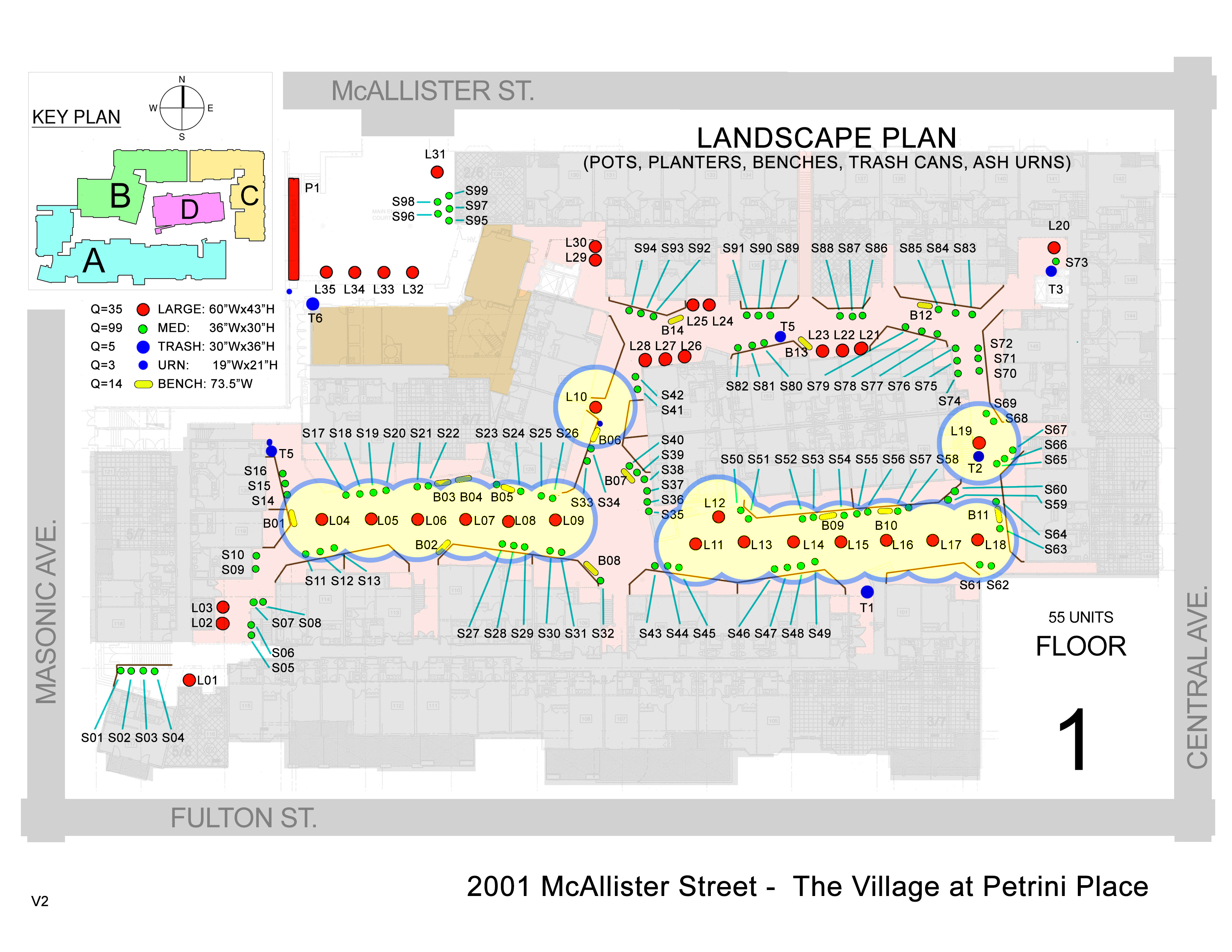
Right CLICK on plan and select “Open Image In New Tab” to view larger version.
Read the previous 2024 LANDSCAPE SURVEY RESULTS (CLICK)


Dear Owners,
The HOA Board and Bay West Property Management would like your input about the dying Japanese maple trees in the inner courtyard. Feedback will be considered as the Board and property management navigate the complexities and costs of keeping our landscaping well-maintained. Please note that some if not all trees may still be removed for safety purposes.
Setting the Stage – Current OVERALL Issue with Landscaping:
- The irrigation system no longer functions and repairing is cost prohibitive. Therefore, our landscapers hand water each week which fortunately, does not add to the contract cost.
- Over the past 23 years, many pots have been damaged and removed leaving gaps in the landscape plan.
- Many of the original trees and plants have been either removed or replaced. For many of the smaller pots they only contain ground covers since original plants have not been replaced.
- Some trees and plants are thriving as they are either new or have been protected from wind and sun.
- For existing pots (either currently empty or full) putting in new plants / trees could result in pot breakage as they are very fragile. The difficulty of root ball extraction makes it very expensive as well. If a pot breaks, identical pots are no longer available. In many cases, it may be more cost effective to simply replace both old pot and tree/plants.
- The cost to replace all pots and plants on the property would well exceed $500,000. An even more measured and staged approach would be out of range of our current budget and reserves. And a staged approach would be unfair to some owners who would wait for years before pots near their unit were updated.
- Given the recent cash needs for SB-326 deck inspections, painting and property insurance, the Board has halted large-scale landscaping projects. The Board instead, has chosen to maintain as best possible the current landscaping components with advice from our landscapers. The Board has done targeted improvements (front entry trimming and limited plantings to keep up the appearance of the property’s entry – also cutting back princess flower bushes which successfully allowed them to regrow). We are now considering another targeted project.
Current SPECIFIC Problem:
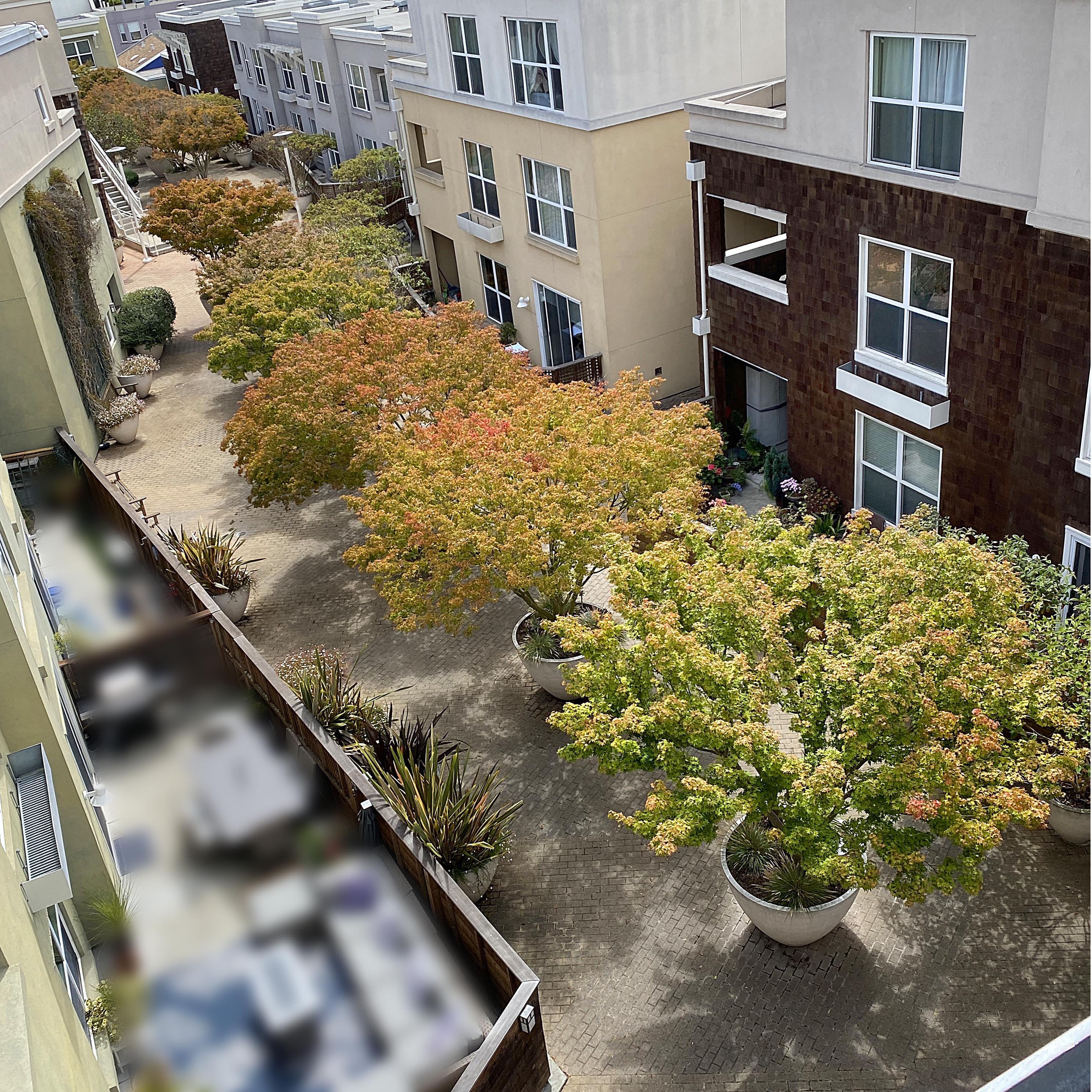
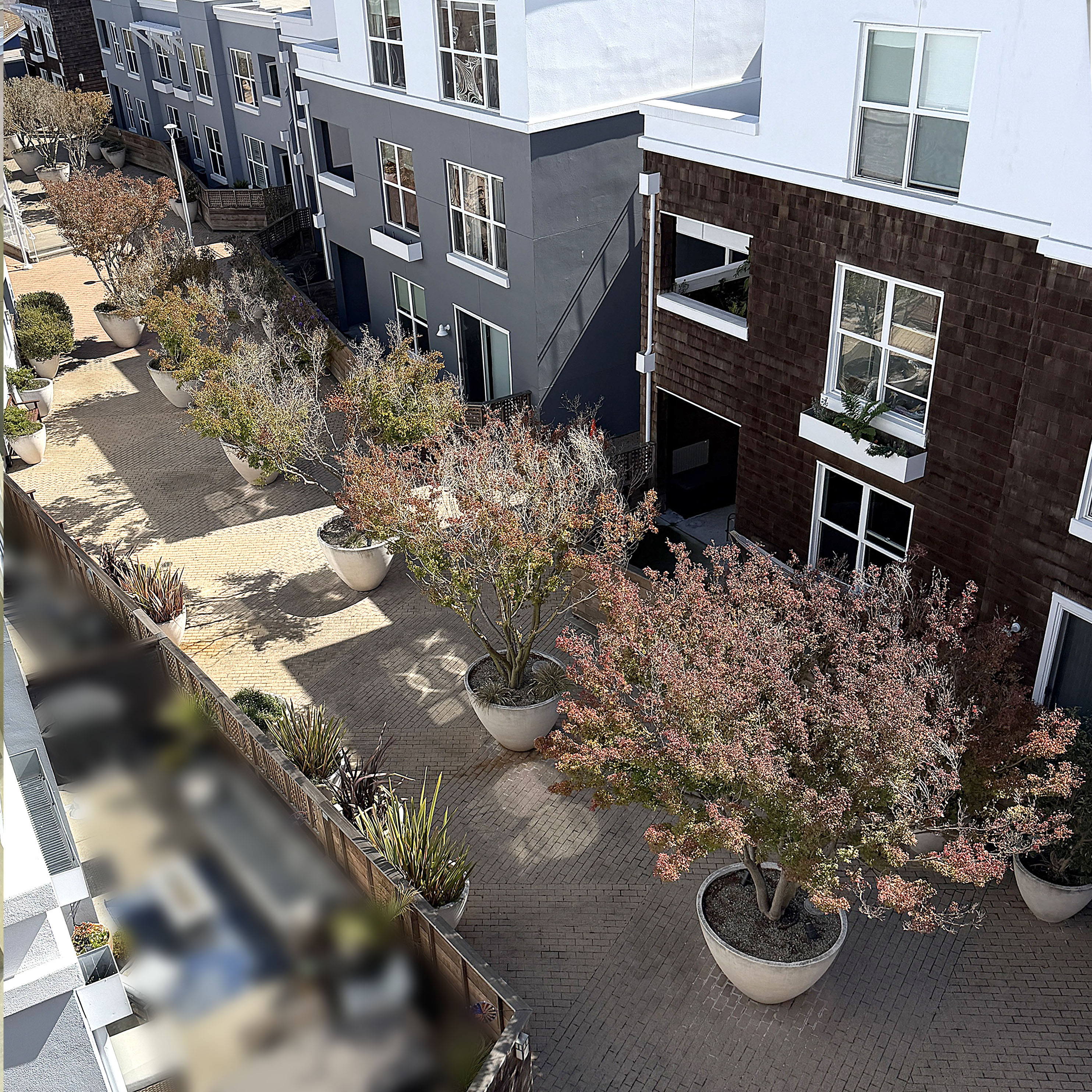
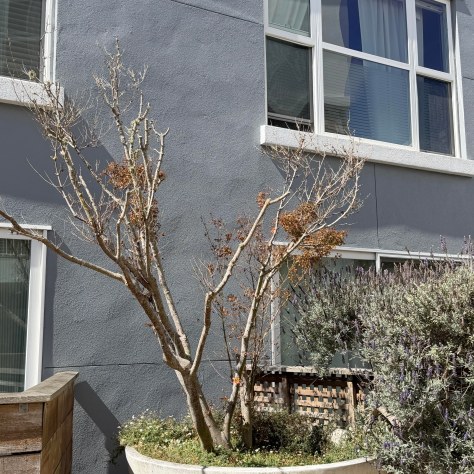
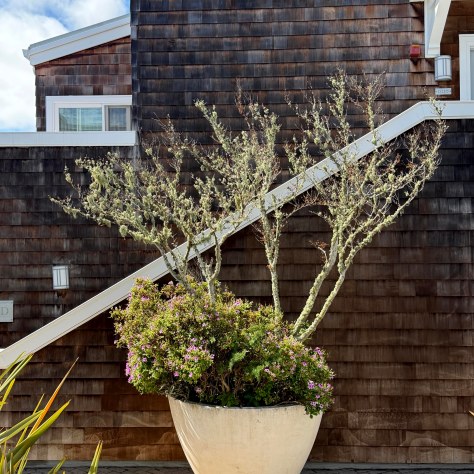
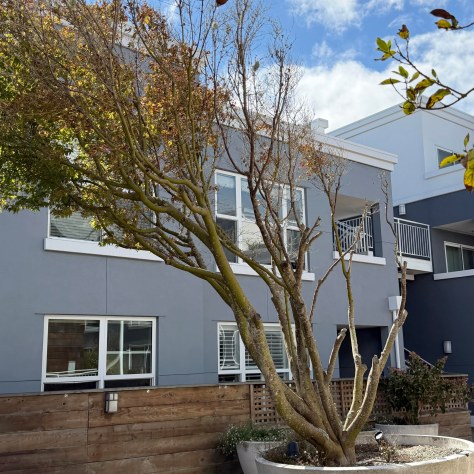
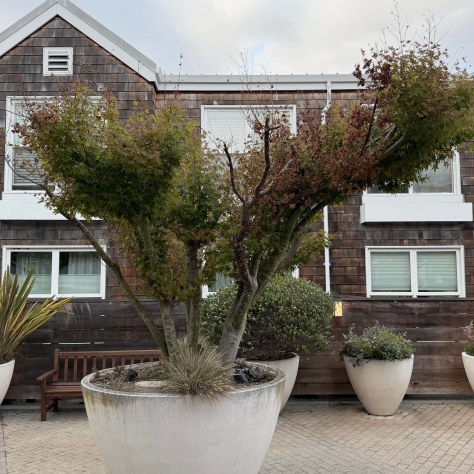
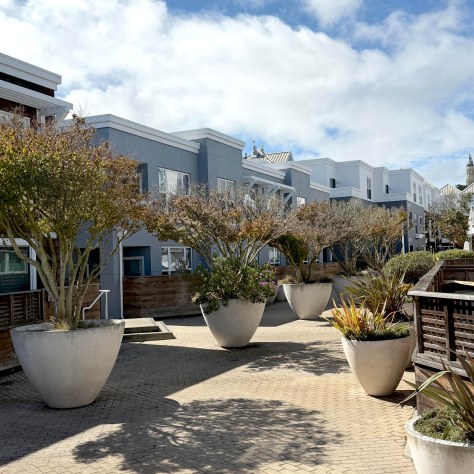
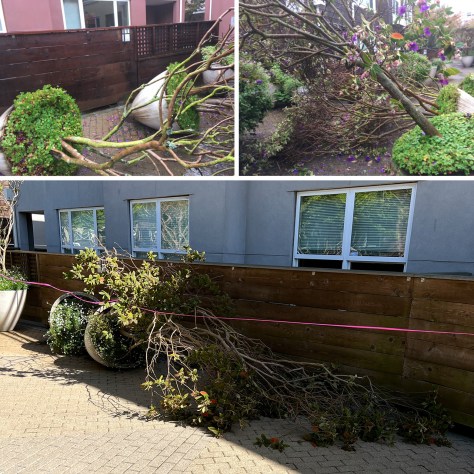
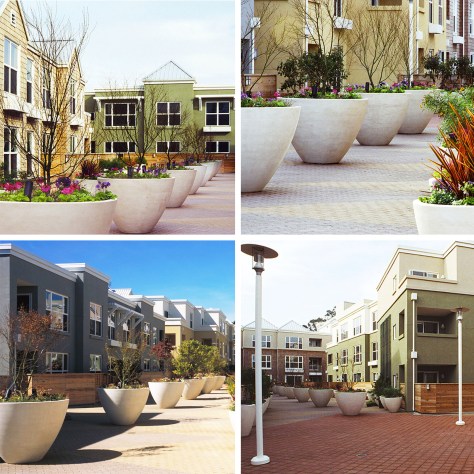
There are 16 Large Pots in the courtyard along A-Building (see yellow highlighted pots on map and photos) which contain Japanese maple trees and one Ficus. They have been growing in these pots since Petrini opened in 2002. Now, two trees are dead with the remaining in various stages of decline. For the past several years large sections of the trees die and are pruned back. As more dying sections are removed, the trees appear disfigured and cannot regain their original health.
FACTS – Trees in general have a limited lifespan when planted in pots (especially if the roots are not trimmed regularly):
- Stress of exposure to wind and direct sun reduce lifespans.
- Hand watering potted plants is not as effective as growing directly in the ground where they can develop a broader and deeper root system. They may not get adequate water in hot and dry seasons and they can get too much water in the rainy season.
- As trees become more root bound, they cannot absorb water and nutrients easily which accelerates their decline.
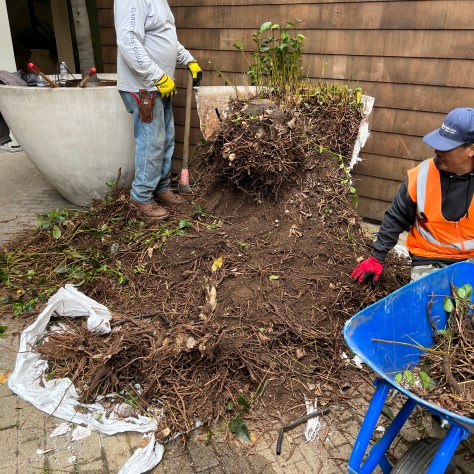
- When a tree does die, we have to remove it either by cutting it at its base (inexpensive) or by removing it and its root ball from the pot (expensive with a high potential to break the pot).
FACTS – Unhealthy and Dying Trees:
- Shed leaves throughout the year (not just in the fall). These leaves litter the courtyard and build up in courtyard facing patios.
- Dying branches are hazardous as they can break and fall on residents and can be trip hazards.
- Dying trees are home for disease and pests which once established can spread to other trees on the property.
- Root-bound trees, especially during storms where wind pressure puts stress on the tree and root ball, easily crack cement pots. Cracked pots are immediately removed for safety. Pot removal is quite expensive and leaves a space in the courtyard with irrigation and electrical wiring exposed.
- Missing pots and pots with half dead trees are not visually pleasing and make the property look unmaintained.
FACTS – Even with unhealthy and dying trees, existing maples do provide:
- A sense of scale and focus for courtyard landscaping.
- A bit of protection against wind and some shading during the hotter months.
- A sense of privacy during the periods when leaves are present.
- Some sound reflection abatement when leaves are present.
The Board is now coming to a decision point on the 16 dying potted trees and is considering several options:
OPTION A) Do nothing other than prune away dead branches and cut each tree down as it completely dies.
- This would leave gaps throughout the existing row of trees when one is cut down and disfigured trees as dead branches are pruned back.
- The cost for pruning and and/or cutting individual trees is relatively affordable over time but would add up to be much more than a simultaneous effort to cut down all 16 trees and haul away the debris.
- Pests and/or disease can spread quickly to other trees, plants and pots accelerating problems.
OPTION B) Replace all 16 pots with new pots, each with a new tree and small plantings around the base:
- Although we do not have solid quotes, the approximate cost to remove 16 pots and contents, rework the irrigation and electrical connections, purchase and install new pots with new soil and then plant new trees (with enough maturity, height and canopy, e.g. a tree older than 5-6 years old) and small filler plants at the base would be substantial.
- Cost would be well over $125,000. It is also not budgeted and would not be prudent to spend this from our reserves.
- Doing only the 16 problematic large pots would make the property appear not uniform since one area would look new and well maintained, while other areas would be worn and lack plants.
- This could be paid for with a Special Assessment which requires a majority of members to vote YES. From past surveys and experience – it would be difficult to get consensus to move forward.
OPTION C) Continue to develop a long-term strategy and set priorities for Petrini’s landscaping.
- The cost of replacing all landscaping (new pots, trees and plants) would be substantial and perhaps greater than $500,000. Even partial approach (only large pots with new trees or only small pots with new plants) would still be well over several hundred thousand dollars. This approach would update Petrini and make the property look substantially new.
- Funding this project would have to be balanced against other needs (potential elevator replacement, future deck repairs, fob system replacement, painting cycles and any other major infrastructure). Although landscaping can be considered “nice to have” compared to a “need to have” elevator, landscaping appearance does affect quality of life and property values.
- A more measured approach can still be designed with perhaps trying to keep existing pots, adding more plants to the smaller planters initially. Then as the trees in larger pots die, replace them with smaller plants to avoid emptying the pots.
OPTION D) After most leaves have fallen from the maples – cut the 16 trees flush with surface, dispose of debris.
- The cost for this is $4150.
- We have additional quotes for $2050 (One Gallon size grasses) and $3145 (Five Gallon size grasses). Each quote specifies at least 3 new plants per pot to fill in the empty spaces. The larger Five Gallon plant sizes would make the pots appear fuller and more established. It also includes removing any unhealthy plants, amending the soil as needed, and leaving healthy plants.
- By cutting the trees down flush and putting in additional filler plants, we would maintain a more uniform and well-maintained appearance. It would also reduce the potential for cracked pots and other damage.
Overall, OPTION D is a prudent approach that keeps the property safe and the appearance of the inner courtyard more uniform and maintained. We can also develop OPTION C to ensure a long-term beautification strategy is in place.
The Board and Property Management would like to hear from owners (please keep in mind that we may still need to cut down and remove trees for safety purposes):
- Comment on the current landscaping condition, especially the dying maple trees in the courtyard.
- Comment on Options A-D.
- Comment on how you see landscaping as a priority on the property, how you see it adding to quality of life or the overall property value.
- Comment on your willingness to have your higher HOA fees (to pay for more landscaping) or a Special Assessment made specifically to pay for major landscaping improvements.
Please enter your Unit #, email and comments below by October 15th, 2025. Thank you for your participation – Petrini Place HOA Board & Bay West Property Management


 The Village at Petrini Place
You must be logged in to post a comment.